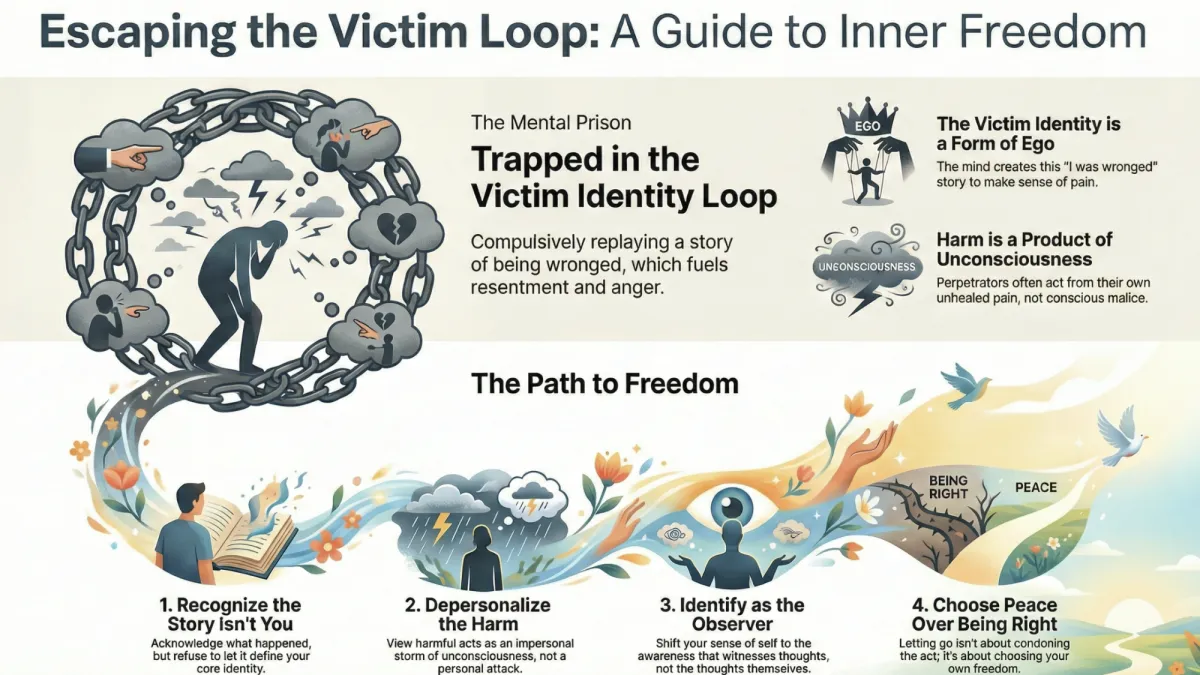
The Victim Loop
Here is a dissection and rewrite of the passage, structured into your plan of action and translated into your voice—the voice of a trauma and addiction survivor who has moved beyond the identity of a victim.
The Problem I Faced
My mind was stuck in a prison of its own making. I was caught in a negative loop, a constant, compulsive replay of the story where I was betrayed, mistreated, and victimized. For years, this loop was my reality. The resentment and anger were like a fire I kept feeding by dwelling on the same thoughts and images. I knew it was keeping me stuck, I knew it was "preventing a higher energy" from coming through, but the story was mesmerizing. I felt frustrated with myself, trapped in my own mental prison, unable to be the "observer" of my thoughts because I was so completely identified with them. Being a victim became my identity.
Why This Was Happening
This is the hard but crucial truth I had to face: the victim identity, even when completely justified by real events, is a form of ego. It is a conceptual identity the mind creates to make sense of pain. The more I replayed the story, the more I cemented that identity: "I am the one who was wronged." It became my sense of self.
The other key was understanding the people who caused the harm. For a long time, I saw them as malicious, conscious actors who chose to hurt me. That kept me locked in a personal battle with them in my mind. What helped me shift was seeing them through the lens of unconsciousness. Tolle's point, echoing the phrase "forgive them, for they know not what they do," hit home. Unconscious people—those in the grip of their own unhealed
trauma, conditioning, and ego—have virtually no free will. They are run by their past, by their own pain. My father's anger, for example, was like living near a volcano; it was a destructive force of nature he could not control because he lacked the awareness to do so. The harm done to me was, in a sense, a natural disaster caused by human unconsciousness. This isn't about excusing the behavior or denying the pain. It's about changing how I relate to it in my mind so I can be free.
What Worked For Me: Escaping the Mental Prison
Here is how I moved beyond the victim loop. This has nothing to do with denying what happened. I see it fully. I know the emotions it created. Going beyond it is about choosing not to live there anymore.
First, I had to see the prison door. I had to recognize that every time I indulged the thought loop, I was choosing to rebuild my cell. Seeing the victim identity as a mental construct, an egoic story, was the key. I was not denying the facts; I was changing my relationship to the story. My mantra became: "That happened to me, but it is not who I am."
I practiced depersonalizing the harm. This was the game-changer. I started to view the actions of those who hurt me as events caused by unconsciousness, like being struck by lightning or living near a erupting volcano. They "knew not what they did" because they were asleep in their own pain. This removed the poisonous, personal sting of "Why me? Why did they do this to me?" It became: "I was in the path of a destructive storm of unconsciousness." This perspective isn't forgiveness for their sake; it's a release of a toxic burden for my own peace.
I focused on my own awareness, my "Deep I." Tolle calls it the Deep I—the awareness itself, not the personality or the story. My work became shifting my sense of self from the wounded surface personality (the victim) to the deeper awareness that witnesses it all. When the old loop started, I would say, "Here is the old story again. I see it. I feel the anger it triggers. But I am the space in which this story is playing, not the story itself." I anchored myself in that space, even for a few seconds, by feeling my breath or the weight of my body in the chair.
I accepted that this is a process, not a one-time decision. I did not arrive at full forgiveness overnight. The first step was simply the understanding: they couldn't have done otherwise given their level of consciousness. That alone began to loosen the knot. From there, I could choose, moment by moment, not to feed the loop. I would consciously redirect my attention to something in the present—a task, a sensation, a breath—when I felt myself being pulled into the mesmerizing story.
Ultimately, I chose freedom over being right. Clinging to the victim identity felt like justice, but it was a prison sentence I was serving long after the perpetrators had left the scene. Letting go was not saying what they did was okay. It was saying that my peace is more important than my resentment. I suffered the consequences of their unconsciousness for years. My work was to stop suffering those consequences by no longer identifying with the one who was harmed, and instead identifying as the one who is free. The loop only has power if I believe it. I stopped believing it, and the walls of the prison dissolved.