The Stoic Warrior Ethos
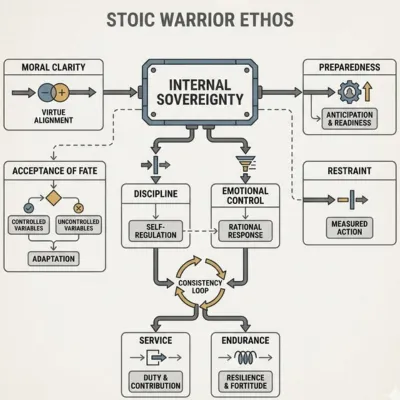
Core premise
The Stoic warrior is not driven by rage, honor theater, or victory fantasies.
He is driven by duty, clarity, and self-command under pressure.
War is not the goal.
Readiness is.
1. Internal sovereignty (primary battlefield)
The self is the first and last domain of control.
Emotions are inputs, not commanders.
Fear, anger, desire are data to be managed, not enemies to be destroyed.
Loss of inner control is considered defeat, regardless of external outcome.
Rule: If you cannot command yourself, you are unfit to command anything else.
2. Discipline over motivation
Action is not contingent on mood.
Readiness is built in advance, not improvised.
Training continues in boredom, fatigue, and doubt.
Rule: Do not rely on intensity. Rely on structure.
3. Acceptance of fate, resistance to weakness
Events are accepted without complaint.
Weak responses are not accepted.
Pain, delay, loss, and uncertainty are expected conditions.
This is not resignation.
It is non-negotiable realism.
Rule: Accept the world as it is. Refuse to become lesser because of it.
4. Moral clarity under pressure
Right action is chosen even when costly.
Expedience is rejected if it violates principle.
Justification after the fact is considered corruption.
The Stoic warrior does not outsource ethics to circumstance.
Rule: Pressure reveals character. It does not excuse its absence.
5. Emotional containment, not suppression
Emotions are allowed to arise.
They are not allowed to dictate action.
Expression is controlled; leakage is waste.
Calm is tactical.
Rule: Feel fully. Act deliberately.
6. Preparedness for loss
Death, failure, exile, and disgrace are mentally rehearsed.
Nothing essential is placed outside one’s control.
Attachment is moderated to preserve function.
This reduces panic and prevents desperation.
Rule: What you have already faced in the mind cannot break you in reality.
7. Service beyond self
The Stoic warrior acts in service of something larger:
duty
order
protection
example
Ego is considered a liability in combat and leadership.
Rule: You are not the mission. You serve the mission.
8. Silence and restraint
Boasting is unnecessary.
Complaining is corrosive.
Explanation is optional; performance is not.
Competence speaks. Noise distracts.
Rule: Say less. Be reliable.
9. Endurance without bitterness
Hardship is met without resentment.
Injustice is addressed without hatred.
Fatigue is managed, not dramatized.
The warrior remains usable.
Rule: Do not poison yourself while enduring the fight.
10. Readiness without aggression
Violence is a tool, not an identity.
Strength exists without constant display.
Calm capacity is more important than intimidation.
Rule: Be capable. Do not posture.
Summary operating statement
The Stoic warrior maintains inner order under external chaos, acts according to principle under pressure, accepts fate without surrender, and remains useful regardless of outcome.