Sacred Geometry
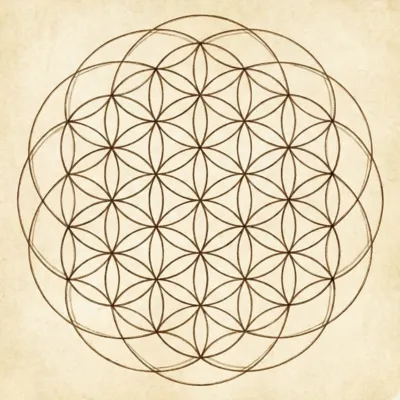
Sacred Geometry isn’t about mysticism or decoration.
It’s a cognitive compression system - a way the mind encodes complex relationships into stable, repeatable forms.
At its core, sacred geometry functions as symbolic cognition:
thinking with structure instead of language.
What sacred geometry actually is
A visual language of relationships, not beliefs
Encodes proportion, symmetry, recursion, and balance
Compresses abstract laws into simple forms
Allows the mind to see coherence instead of reasoning it step-by-step
Operates below verbal thought, but above raw perception
This is why these forms show up independently across cultures.
They are intelligible, not inherited.
Core cognitive functions
Pattern stabilization
Repeating forms anchor attention
Reduce cognitive noise
Create a reference structure the mind can return to
Relational mapping
Shows how parts relate to wholes
Inner to outer
Center to perimeter
Cause to effect
Static symbols that imply dynamic movement
Memory compression
One image replaces many sentences
Geometry becomes a mnemonic container
Allows recall of principles without verbal rehearsal
Pre-rational coherence
Works before logic kicks in
Similar to Nous rather than Logos
The form is “recognized” before it’s explained
Common forms and what they encode cognitively
Point
Origin
Attention
Awareness without content
Line
Direction
Intention
Movement from origin
Circle
Totality
Boundary
Containment
Self-reference
Triangle
Stability through tension
Minimal structure
Dynamic balance (thesis / antithesis / synthesis)
Square
Order
Constraint
Structure
Grounded systems
Spiral
Growth without repetition
Time as progression
Pattern evolution
Grid / lattice
Field organization
Information space
Possibility mapping
These are not metaphors.
They are cognitive operators.
Why symbolic cognition matters
Language is slow and sequential
Geometry is simultaneous
Symbols allow parallel processing
Complex systems can be grasped at once
This is why diagrams often produce insight faster than explanation.
Stoic-compatible framing
Sacred geometry aligns with Stoic practice when used as:
A clarity tool, not a belief system
A way to visualize order without myth
A method for stabilizing judgment
A way to keep Logos aligned with Nous
Used correctly, geometry disciplines the mind instead of enchanting it.
Failure modes (important)
Treating symbols as truth instead of representations
Replacing judgment with aesthetic reverence
Confusing pattern recognition with understanding
Using geometry to bypass thinking instead of support it
Stoic use demands instrumental clarity, not devotion.