Mantra, Yantra, Mandala
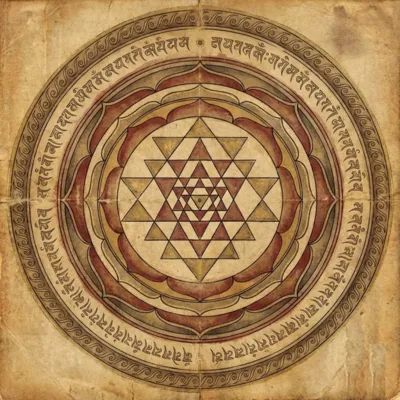
Think of these as three interfaces to the same thing, working at different depths of cognition.
Mantra - cognitive alignment (sound + language)
Mantra is auditory and linguistic.
It works by repetition, rhythm, and compression.
The goal is not meaning at first, but entrainment.
Over time, meaning emerges as the mind stabilizes around the phrase.
Functionally:
Trains attention
Interrupts mental noise
Rewrites internal cadence
Acts as a portable anchor
Mantra answers:
“What am I returning my mind to?”
Yantra - symbolic focus (form + geometry)
Yantra is visual and geometric.
It gives the mind a precise object to rest on.
Geometry replaces narrative.
Attention narrows without force.
Functionally:
Stabilizes perception
Trains sustained focus
Bypasses verbal thinking
Creates coherence through form
Yantra answers:
“What form holds my attention steady?”
Mandala - integrative field (wholeness + orientation)
Mandala is spatial and holistic.
It represents a complete psychic field, not a single point.
You don’t focus on a mandala. You enter it.
It mirrors the total pattern of experience.
Functionally:
Integrates opposites
Restores perspective
Allows meaning to self-organize
Reveals where attention naturally moves
Mandala answers:
“Where am I, as a whole?”
How they work together (this is the key)
Mantra stabilizes the mind
Yantra stabilizes the attention
Mandala stabilizes the self-image
Or more bluntly:
Mantra = tune the signal
Yantra = lock the signal
Mandala = see the signal reflected
This is not mystical fluff. It’s multi-modal cognition training.